


Bruce Tuckman (Psychologist) is well known for his team development phrase and concepts of, “Forming, norming, storming, and performing.” I have uttered these words many times over my organizational development and leadership work in workshops, team meetings and retreats. My desire of being the forever cheerleader of bringing people together in the spirit of creating a colorful pallette of wisdom to have our work together be as meaningful and purposeful as possible. The creation of building a high performing team is rooted in high emotional intelligence and clarity of expectations of individual team members, their contribution, responsibilities, and relationships.
What are Team Norms?
Penn Medicine Academy share in their Guide to Developing Team Norms (nd, p.1) that “Norms are guidelines for how the team members will interact and communicate. Norms help to clarify the expected behavior of individuals on the team and prevent unnecessary conflict” (p.1) leading to:
- Effective decision making.
- Clear expectations for how the team interacts and performs.
- Effective assimilation of new team members.
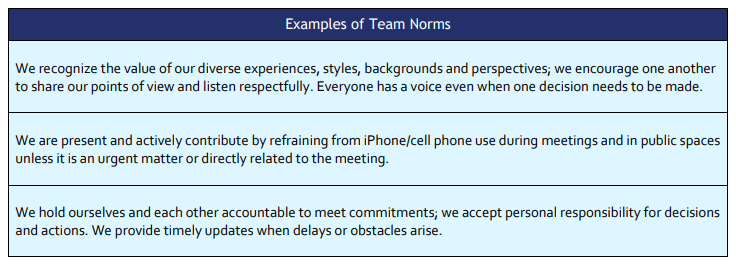
participate, contribute and interact with one another to achieve team goals and results
Creating Team Norms
Dufour et al (2016) give us 6 tips to creating team norms:
- Teams create their own norms
- State norms as commitments of actions or behaviors
- Review norms at the beginning and end of meetings for the first six months
- Formally evaluate norm effectiveness 2 times a year (minimum)
- Keep the color pallet basic with an essential list of essential norms
- Have one overarching clarifying norm to deal with non-observance of team norms
I love words of wisdom from leadership, coaching and social/emotional intelligence experts who have been at the forefront on leading high performing teams through creative opportunities for decades. They lay the pallet of discovery for us, and allow us as leaders the space to create our own ways of being for our specific teams based on their learning. Dufour et al (2016, p.78) summarize leadership thoughts from these experts with:
Why Should We Create Norms?
Teams improve their ability to grapple with the critical questions when they clarify the norms that will guide their work. These collective commitments represent the “promises we make to ourselves and others, promises that underpin two critical aspects of teams – commitment and trust” (Katzenbach & Smith, 1993, p. 60).
Explicit team norms help to increase the emotional intelligence of the group by cultivating trust, a sense of group identity, and belief in group efficacy (Druskat & Wolff, 2001).
When self-management norms are explicit and practiced over time, team effectiveness improves dramatically, as does the experience of team members themselves. Being on the team becomes rewarding in itself — and those positive emotions provide energy and motivation for accomplishing the team’s goals” (Goleman, Boyatzis, & McKee, 2004, p. 182).
Norms can help clarify expectations, promote open dialogue, and serve as a powerful tool for holding members accountable (Lencioni, 2005).
Referring bac to the norms can help “the members of a group to re-member,” to once again take out membership in what the group values and stands for; to “remember,” to bring the group back into one cooperating whole” (Kegan & Lahey, 2001, p. 194).
Inattention to establishing specific team norms is one of the major reasons teams fail (Blanchard, 2007).
After looking at over a hundred teams for more than a year, researchers concluded that understanding and influencing group norms were the keys to improving teams. Researchers noted two norms that all good teams generally shared. First, members spoke in roughly the same proportion. Second, the good teams were skilled at intuiting how others felt based on their tone of voice, expressions, and other nonverbal cues (Duhigg, 2016).
High Performing Teams and Why Norms Matter:
Lencioni (2003) as cited in Dufour et al (2016) shines light on the building block of vulnerability-based trust (p. 71) and with that team members will utilize their knowledge of strengths and weaknesses in self and others to learn through mistakes and failures. A study by Druskat & Wolff (2001), cited by Dufour et al (2016, p. 72), suggest that members of high performing teams consistency display several characteristics of emotional intelligence.
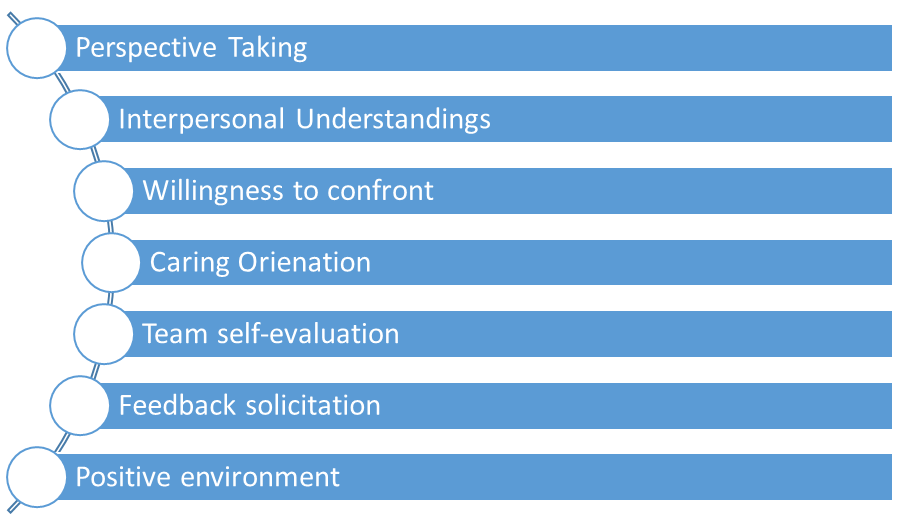
Setting team norms through reflection, honest open dialogue and clear expectations will provide time and space for teams to design, learn and grow together as team that is moving forward together with trust and knowing that the commitments they make together are a guide to positive communication and high team performance.
References
DuFour, Richard, D., Rebecca, Eaker, Robert, Many, Thomas W., & Mattos, Mike. (2016). Learning By Doing: A Handbook for Professional Learning Communities at Work (Third). Solution Tree.
Penn Medicine Academy. (n.d.). Tools for Developing Effective Teams. Med Upenn. https://www.med.upenn.edu/uphscovid19education/assets/user-content/documents/leading/guide-to-establishing-team-norms-final.pdf
Mind Tools. (2022). Forming, Storming, Norming, and Performing. Mind Tools. https://www.mindtools.com/pages/article/newLDR_86.htm#:~:text=Psychologist%20Bruce%20Tuckman%20came%20up,their%20way%20to%20high%20performance.