

In line with Jarvis (2015) in her video introducing transformative learning theory, I picture transformation (especially this time of year) as a monarch caterpillar eating up as much milkweed as they possibly can to then attach itself to any surface that is within their place of being to contort themselves into a cocoon. From this web of magic, it can look like a place of dormancy to the outer world, yet it is a safe and nourishing space where transformation takes place and a beautiful, strong butterfly capable of soaring to heights that one could not previously imagine emerges. Isn’t this like the spaces and places that Professional Learning Communities and Personal Learning Networks bring us? We build our communities and networks often times for the work, or the project or for the learner, and know not the outcomes that we ourselves will have been graced with. We may hunker down in the comfort of the community or grow, stretch and challenge self in the discomfort too.
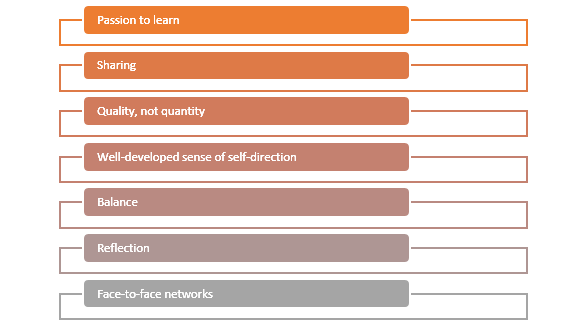
PLNs – a.k.a, the places and spaces that allow us to grow professionally and personally, to be connected to people, community and content. To feed our development in a way that stretches what we know and how we learn and to share our learning and growth with others in person and virtually (across the meeting table or the world). Richardson & Mancabelli (2011, p.35) provide us Guideposts for Learning in Networks that feel essential to what helps us to transform our leadership knowledge, skills and abilities beyond the status quo:
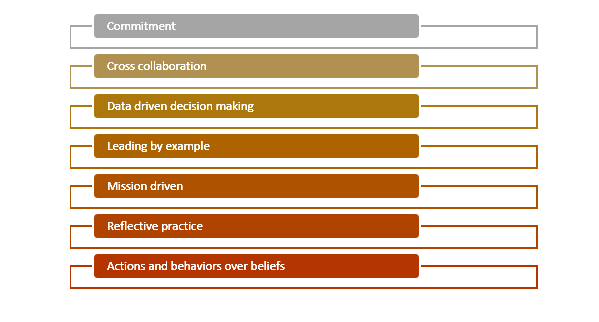
PLCs – a.k.a., the place of commitment, to colleagues, to learners and to self. The spaces where collaboration if forefront, where the focus is on the learning, and outcomes and results are an essential part of the community. The PLC feels to me as a more formal experience than diving full-on into a PLN; however DuFour et al (2016) reminds us that the PLC is meant to “empower educators to make important decisions and encourages their creativity and innovation in the pursuit of improving student and adult learning” (p. 13). Based on the work of DuFour et al (2016), I have parsed out a few of the components of a PLC that can cross function as building blocks of a transformational leader:
Ultimately, an essential common thread that I see between the PLC and the PLN is educators learning from, with, and about each other – the true sense of interprofessional education. These networks/communities allow us opportunity to expand and share our knowledge and in the spirit of Jarvis (2015) to radically change the way that people think and feel…to see profound changes in learners and to become transformational leaders. Through my eyes, healthcare education has been in significant transformation in the past 2.5 years. Covid-19 forced us to move at the speed of light and to figure out new ways to education our residents and fellows through the use of technology, ultimately as I have previously written creating accidental learning communities. Wellness and well-being of healthcare professional has been in the spotlight long before C-19 hit our world and there is important research over the past 10 years that gives voice to the reality of burn-out and challenges in medical education. The following article summaries (one from the Covid-19 era, and one from a previous decade) discuss transformational leadership (and its importance to learning and employee engagement) and tap into components of both a PLC and PLN.
van Diggele et al (2020) and Nielsen & Munir (2009) contributions suggest that transformational leaders positively impact their learners/team members/followers. Although medical education does not utilize the formal language of a PLC or a PLN, there are learning opportunities that are consistent with these formal practices. Grand Rounds, be it nursing, medicine or quality are integral to the learning of healthcare professionals on topics such as leadership, diversity, equity, inclusion and belonging and specialty related practice. Morbidity and Mortality Rounds are deep dives into clinical practice and a means to improve quality and patient safety. Within these learning experiences, residents/fellows and faculty rely on each other for the direction that the learning. To achieve better patient outcomes, van Diggele et al (2020) summarize leadership strategies:
- Healthcare educators need leadership and management skills
- Leadership through influence without authority is necessary no matter the level of one’s role
- Emergent leaders role model autonomy and accountability, teamwork
- Education is inclusive of a focus on patient outcomes
They point out that transformational leaders transform individuals and use teaming to achieve organizational goals. I appreciate their focus on of Bass & Aviolo’s four “I’” of transformational leadership, Idealized Influence, Inspirational Motivation, Individualised Consideration, Intellectual Stimulation as a means for leaders to lead with clarity through values and vision.
Healthcare educators are most often practicing providers with clinical responsibilities (surgery, patient rounds, and outpatient clinics) as well as other administrative functions. It can be a challenge to shift on any given day between their competing priorities and there doesn’t ever seem to be enough time for either the patient or the learner. “At some point, most leaders in healthcare education need to make a decision about their leadership direction, and whether it lies predominantly in higher education…” (p. 3) van Diggele et al (2020). This is a struggle – how do we provide for processes that are consistent in nature of a PLC when we know that our clinical educators are already stretched thin? Interprofessional education and teams are the wave of the future and investments in social capital, van Diggele et al (2020), can support leadership development in organizations. This continues to be a hot topic in healthcare professions education and likely not one to be solved for in the immediate future. Nielsen & Munir (2009), an older article, yet important for the context of today’s world of medicine and the prevalence of burn-out and the challenge this imparts on developing transformational leaders. Building leadership competency takes time, yet is essential for self-efficacy and wellbeing of followers in their own development of transformation leadership behaviors (p.323).
There is much more for healthcare to learn about the use of PLCs and PLNs within the healthcare educational setting, or at the least in the formal sense. Transformational leadership is ripe for the picking in healthcare education and we are making movements every day.
References
Dufour, R., Rebecca Burnette Dufour, Eaker, R. E., Many, T. W., & Mattos, M. (2016). Learning by doing : a handbook for professional learning communities at work. Solution Tree Press.
Jarvis. (2015, August 15). introducing transformative learning theory [Video]. YouTube. http://www.youtube.com/watch?v=liU1zsi3X8w
Nielsen, K., & Munir, F. (2009). How do transformational leaders influence followers’ affective well-being? Exploring the mediating role of self-efficacy. Work & Stress, 23(4), 313–329. https://doi.org/10.1080/02678370903385106
Richardson, W., & Mancabelli, R. (2011). Personal learning networks: using the power of connections to transform education. Solution Tree Press.
van Diggele, C., Burgess, A., Roberts, C., & Mellis, C. (2020). Leadership in healthcare education. BMC Medical Education, 20(S2). https://doi.org/10.1186/s12909-020-02288-x